

Website Architecture is the hidden framework that holds everything together. Visitors may not see it directly, but they feel it instantly—through smooth navigation, fast loading pages, and clear structure. Search engines feel it too. If Google can’t understand your site structure, ranking becomes an uphill battle.
In this guide, we’ll break down Website Architecture in a simple, human way—no jargon, no fluff—just practical insights that help both SEO optimization and UX thrive.
What Is Website Architecture?
At its core, Website Architecture is how your website’s pages are organized, linked, and prioritized. It defines:
- Page hierarchy
- Navigation paths
- Internal links
If your homepage is the heart, internal pages are arteries. Everything must connect smoothly.
Why Website Architecture Matters in Modern SEO
SEO isn’t just about keywords anymore. It’s about clarity, structure, and accessibility. A strong Website helps search engines crawl, understand, and index your pages efficiently.
When your site is logically structured:
- Search bots find pages faster
- Link equity flows smoothly
- Important pages get prioritized
Think of a Website as road signage for Google. Clear signs lead to smooth traffic. Poor signs? Traffic jams and missed destinations.
How Website Architecture Impacts User Experience (UX)
User experience lives and dies by structure. If users can’t find what they need within three clicks, they bounce. And bounce rates send bad signals to search engines.
A clean architecture:
- Reduces confusion
- Improves engagement
- Increases conversion rates
In short, good structure = happy users = better rankings.
Website Architecture vs Website Design
People often confuse design with architecture. They’re not the same.
- Website Design focuses on visuals (colors, fonts, layouts)
- Website Architecture focuses on structure (navigation, hierarchy, flow)
Design attracts users. Architecture keeps them.
Search Engine Crawling and Indexing Explained

Search engines use bots to crawl your site. These bots follow links like humans follow roads. A poor website creates dead ends.
Good structure ensures:
- All pages are reachable
- No orphan pages exist
- Crawl budget is used wisely
This directly impacts how well your pages rank.
User Journey and Navigation Flow
Every visitor arrives with a purpose. Your website should guide them naturally from the entry point to conversion. Ask yourself:
- Can users move logically from page to page?
- Is navigation intuitive?
- Are key pages easy to access?
If users get lost, your structure needs fixing.
Internal Linking as a Structural Backbone
Internal links are the glue holding your website together. They:
- Distribute authority
- Improve crawlability
- Guide users deeper into your site
Smart internal linking creates a web of relevance, not randomness.
Flat vs Deep Website Architecture
Flat Architecture
- Fewer clicks to reach pages
- Better for SEO
- Ideal for small to medium sites
Deep Architecture
- Many layers and subfolders
- Harder to crawl
- Can confuse users
As a rule of thumb, important pages should be no more than 3 clicks away.
Mobile-First Architecture Considerations
Google indexes mobile versions first. If your website doesn’t work on mobile, rankings suffer.
Mobile-first architecture means:
- Simple menus
- Thumb-friendly navigation
- Fast-loading pages
If it’s clunky on mobile, it’s broken—no matter how good it looks on desktop.
Website Architecture for Large vs Small Websites
Small Websites
- Simple hierarchy
- Clear navigation
- Minimal categories
Large Websites
- Category-based structure
- Logical subcategories
- Strong internal linking strategy
The bigger the site, the more important the structure becomes.
Key Elements of a Strong Website Architecture
A solid website includes:
- Clear navigation menus
- Logical URL structure
- Consistent internal links
- Proper use of categories
- XML and HTML sitemaps
These elements function together like a well-oiled machine.
Common Website Architecture Mistakes
Avoid these common pitfalls:
- Too many clicks to key pages
- Overcrowded menus that confuse users
- Broken links or orphan pages that hinder navigation
- Ignoring mobile responsiveness
- Using too many subfolders makes content hard to find
One mistake can weaken your entire SEO foundation.
Best Practices for SEO-Friendly Website
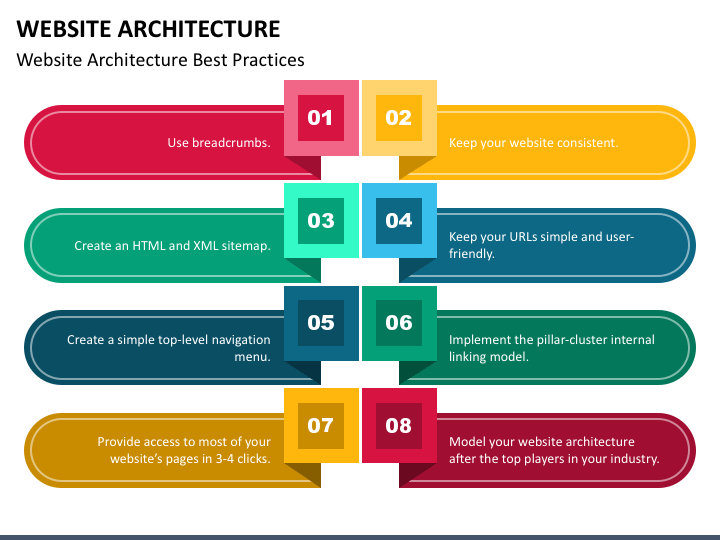
Follow these proven practices:
- Plan structure before building pages
- Keep URLs short and descriptive
- Use breadcrumbs
- Prioritize important pages
- Regularly audit internal links
SEO success starts at the structural level.
How to Audit Your Existing Website Architecture
You don’t need to rebuild everything overnight. Start with an audit:
- Map your site hierarchy
- Identify orphan pages
- Check internal linking depth
- Review navigation usability
Small fixes can lead to big SEO wins.
Tools to Improve Website Architecture
Helpful tools include:
- Google Search Console
- Screaming Frog
- Ahrefs
- SEMrush
These tools reveal structural issues hiding beneath the surface.
Future Trends in Website Architecture
The future of Website Architecture is:
- AI-driven personalization
- Voice-search-friendly structures
- Headless CMS architectures
- Faster, lighter frameworks
Structure will matter more than ever as search evolves.
FAQs
1. What is the main purpose of Website Architecture?
The main purpose of Website Architecture is to organize pages logically so users and search engines can navigate the site easily.
2. How does Website Architecture affect SEO rankings?
A good Website improves crawlability, internal linking, and page authority flow, all of which boost rankings.
3. Can a bad website hurt conversions?
Yes. Poor structure confuses users, increases bounce rates, and reduces conversions.
4. How often should Website Architecture be reviewed?
Ideally, review your Website every 6–12 months or after major site updates.
5. Is Website Architecture important for small websites?
Absolutely. Even small websites need a clear structure to grow and rank effectively.
Conclusion
Website Architecture isn’t optional—it’s foundational. It supports SEO, enhances UX, and drives conversions. Without a solid structure, even top-notch content can get lost. Think of your website as a city. Roads, signs, and layouts matter. Build it smartly, and both users and search engines will reward you.